


Understanding Markets and Price Behavior
The Case Against Active Management
Index Funds and Passive Investing
Risk, Behavior, and Investor Psychology
Building Wealth: Practical Rules for Life
Summary
Related Video
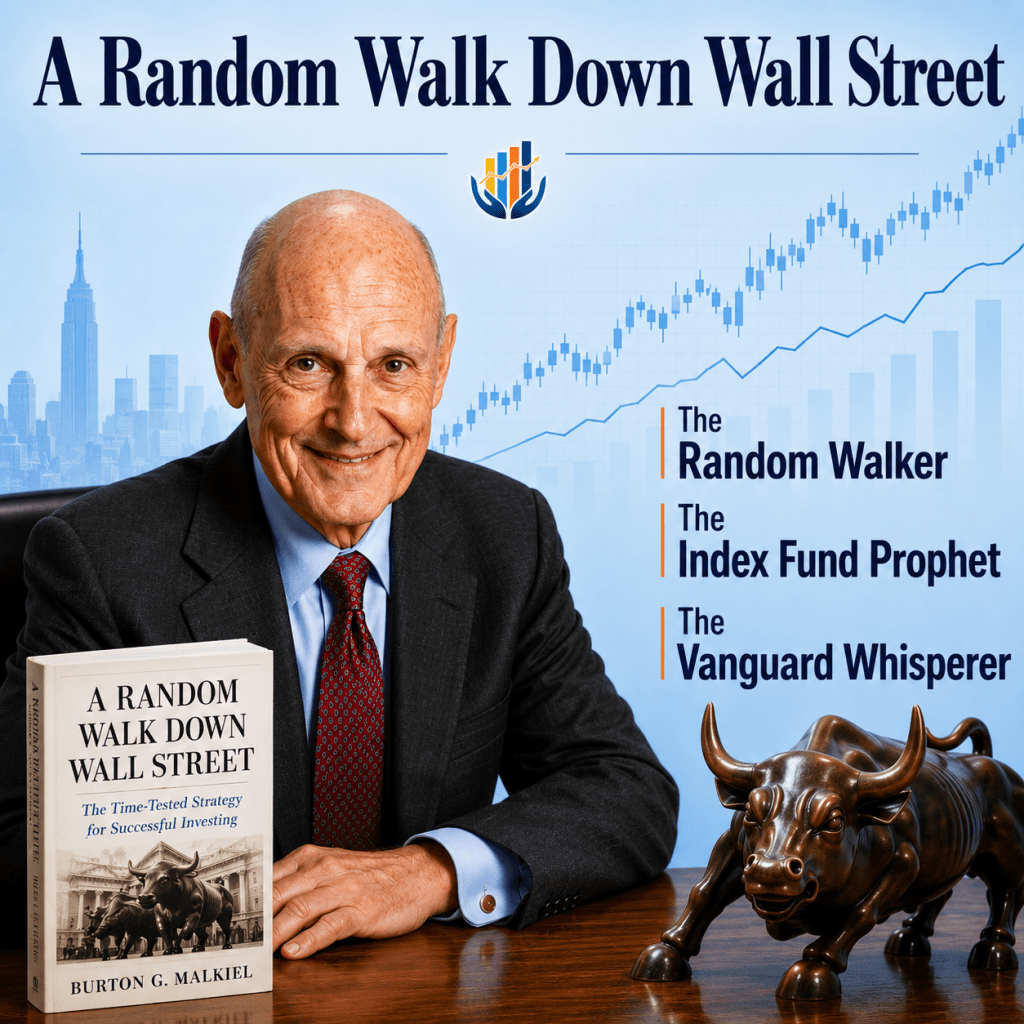
Below are some highlights from the best selling book A Random Walk Down Wall Street by Burton Malkiel. The book was first published in 1973. Mr. Malkiel shows why an individual who saves consistently over time and buys a diversified set of index funds can achieve above-average investment results. In his updated version, he addresses current investment fads and critically analyzes cryptocurrencies, NFTs, and meme stocks. Malkiel reveals how to be a tax smart investor and how to make sense of recently popular investment management techniques, including factor investing, risk parity, and ESG portfolios.
Understanding Markets and Price Behavior
Stock prices move randomly and are extremely difficult to predict.
Malkiel’s core message is that short-term market movements are largely unpredictable because new information gets absorbed into prices so quickly. Yesterday’s stock move usually tells you very little about tomorrow’s.
Markets process information incredibly fast.
By the time most investors react to headlines or earnings reports, Wall Street has usually already priced the information in. That’s why consistently beating the market using public information is so difficult.
Fundamental analysis has limitations.
Studying earnings and business quality absolutely matters, but professional investors are looking at the exact same information every single day. Markets are highly competitive, which limits easy opportunities.
Technical analysis is less reliable than many traders believe.
Charts and patterns may look convincing, but most technical systems struggle to outperform consistently over time. Malkiel argues that investors often see patterns in randomness that don’t actually provide a real edge.
Market bubbles happen repeatedly throughout history.
Speculative manias are part of human nature. Investors become overly optimistic, prices disconnect from fundamentals, and eventually reality catches up.
Markets are often driven by emotion and momentum.
Sometimes investors buy assets simply because they believe someone else will pay a higher price later. Sentiment and speculation can temporarily overpower fundamentals.
The Case Against Active Management
Most active fund managers fail to beat the market.
Research consistently shows that most actively managed funds underperform their benchmarks after fees and taxes. Markets are simply too competitive for consistent outperformance to be common.
Past performance usually doesn’t predict future success.
The hottest fund from last year often struggles the following year. Chasing recent winners is one of the most common investing mistakes.
Fees quietly destroy long-term wealth.
Even small investment fees compound dramatically over decades. Keeping costs low is one of the biggest advantages long-term investors have.
Trading too much usually hurts returns.
Frequent buying and selling creates taxes, commissions, and emotional mistakes. Investors who stay patient often outperform those constantly trying to outsmart the market.
Large institutions face their own disadvantages.
Big funds can’t move money quickly without affecting prices, and many managers face pressure to avoid standing too far away from the crowd. Even professionals deal with structural limitations.

Index Funds and Passive Investing
Index funds are one of the best investing tools ever created.
They provide broad diversification, low fees, tax efficiency, and consistent market exposure. Malkiel strongly believes passive investing is one of the smartest long-term strategies for most investors.
Diversification protects investors from unnecessary risk.
Owning only a few stocks creates avoidable company-specific risk. Broad diversification helps smooth out the damage from individual losers.
Stocks reward patience over long periods.
Historically, stocks outperform cash and bonds because investors are compensated for tolerating volatility. The key is staying invested long enough for compounding to work.
Dollar-cost averaging helps remove emotion.
Investing consistently over time reduces the pressure of trying to perfectly time the market. It creates discipline and keeps investors participating during both good and bad periods.
Rebalancing keeps portfolios disciplined.
Over time, some investments grow faster than others and shift portfolio risk. Rebalancing helps investors maintain their intended allocation without emotional decision-making.
Risk, Behavior, and Investor Psychology
Higher returns always come with risk.
There’s no way to earn strong long-term returns without accepting volatility and occasional drawdowns. Investors often underestimate how emotionally difficult losses can feel.
Time horizon matters enormously.
Young investors can usually tolerate more volatility because they have decades to recover from downturns. Older investors often need greater stability and income protection.
Investor psychology causes many investing mistakes.
Fear, greed, overconfidence, and herd mentality regularly damage investor returns. Emotional decisions often matter more than market knowledge itself.
Overconfidence is dangerous in investing.
Many investors believe they can consistently pick winners or time the market better than they actually can. Overconfidence often leads to excessive risk-taking and unnecessary trading.
Market timing is incredibly hard to do consistently.
Investors must correctly predict both when to exit and when to reenter the market. Missing even a few strong market days can seriously hurt long-term returns.
Building Wealth: Practical Rules for Life
Starting early matters tremendously.
Compounding becomes far more powerful over long periods of time. Even small amounts invested early can grow into meaningful wealth decades later.
Tax-advantaged accounts are extremely valuable.
Retirement accounts allow investments to compound more efficiently by reducing taxes. Over long periods, those tax savings become significant.
A home is not automatically a perfect investment.
Housing includes maintenance, taxes, insurance, and transaction costs that many people underestimate. Buying a home should balance financial and lifestyle goals.
Portfolios should become more conservative with age.
Younger investors generally can tolerate more stock exposure, while older investors often need greater financial stability and lower volatility.
Diversification should extend beyond U.S. stocks.
Different asset classes react differently to changing economic conditions. Broad diversification creates more resilient portfolios over time.
Simple investing often works best.
Complicated products and strategies frequently benefit the financial industry more than the investor. Simple diversified portfolios often outperform more complex approaches after fees and taxes.
Emotional investing usually creates problems.
Bull markets encourage greed while bear markets create fear. Investors who stay disciplined during emotional extremes often achieve the best long-term results.
Summary
Consistently beating the market is extremely difficult.
Markets are highly competitive and efficient, making outperformance rare after costs and taxes. For most people, broad diversification and long-term investing are the most reliable path.
Long-term investing success comes from discipline and patience.
Low costs, diversification, emotional control, and consistency matter far more than trying to constantly outsmart the market. The biggest advantage investors can develop is staying disciplined and avoiding major mistakes.
All content on this site is for informational purposes only and does not constitute financial advice. Consult relevant financial professionals in your country of residence to get personalized advice before you make any trading or investing decisions. This post was written with the assistance of artificial intelligence. The original ideas and final review are human-generated.