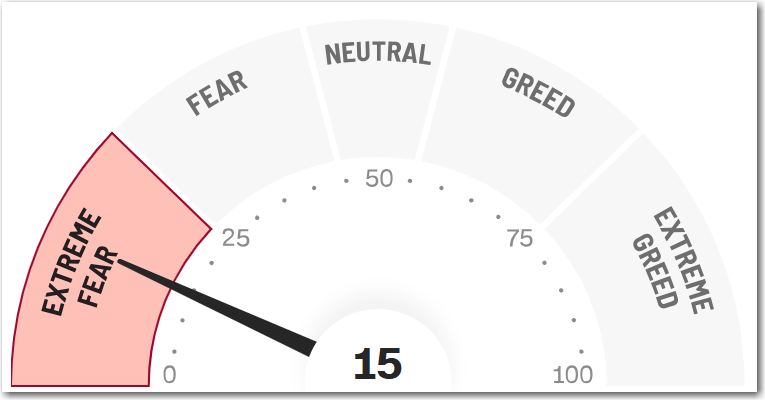
The CNN Fear & Greed Index scores from 0–100, with readings below 25 classified as “Extreme Fear.” Scores of under 25 are labeled “extreme fear,” with the index aggregating seven key indicators reflecting different aspects of market sentiment, including stock price momentum, price strength, put/call ratios, junk bond demand, volatility, and safe-haven demand.
Historical instances of sustained Extreme Fear and what followed
The episodes most comparable to four consecutive weeks of Extreme Fear are:
March 2020 (COVID crash): The index remained in single-digit territory from March 5–23, a period when the S&P 500 lost more than 30% of its value. However, the S&P 500 then rallied by nearly 40% from its April lows — the last time the market was at extreme fear — before reaching new highs by autumn.
April 2025 (Tariff shock): CNN’s Fear and Greed Index plunged to just 3 on April 8, its lowest level since March 2020. The two times in the past year when the index plunged into single digits were great buying opportunities — this happened in early April 2025, before stocks went on a great run until autumn, and again in late November, signaling another bottom with the market closing out the year strong.
What backtests say about buying during Extreme Fear
A backtest of 9,000+ trades across all CNN Fear & Greed decile ranges found that extreme fear requires patience and the willingness to endure continued volatility, while moderate fear (the 20–40 range) offers the best risk-adjusted returns for patient capital. Specifically, the 10–20 range shows solid performance at longer holds — +0.88% at 21 bars (about one month) with a 62.16% win rate — but the 20–40 zone is the clear champion for mean reversion plays over a 3–4 week timeframe.
The key nuance: buying during extreme fear works best with a long holding period, while selling during extreme greed just to wait for the next fear signal to buy is unreliable and can make you miss entire bull market rallies.
The academic picture
A peer-reviewed study found that the Fear and Greed Index Granger causes S&P 500 and Nasdaq Composite returns, though the relationship is considerably weaker in the 2021–2024 period than it was pre-2014. ScienceDirect In other words, the predictive signal from Extreme Fear has diminished somewhat over time.
The bottom line
There is no precise published statistic for exactly “4 weeks of Extreme Fear → 6-month S&P 500 return,” but the available evidence points in one direction: prolonged Extreme Fear has historically preceded strong 6-month recoveries, with the caveat that:
The index doesn’t mark the exact bottom — fear can persist or deepen before reversing.
The first signs of recovery usually emerge once the Fear and Greed Index climbs above 10, but a more reliable signal is a return above 25, which tends to precede sustainable rallies.
The quality of the subsequent recovery depends heavily on whether the underlying macro trigger (pandemic, tariffs, a war) resolves.
In the two clearest modern analogues (March 2020 and April 2025), 6-month returns following multi-week Extreme Fear were strongly positive — roughly +30–40% from the bottom in both cases — but getting in at the exact trough required significant tolerance for short-term volatility.




SubStack Education Posts
https://www.position-trader.com/p/poor-charlies-almanack-by-charles
https://www.position-trader.com/p/the-intelligent-investors-road-to
https://www.position-trader.com/p/the-little-book-that-still-beats
https://www.position-trader.com/p/think-and-grow-rich-by-napoleon-hill
https://www.position-trader.com/p/security-analysis-by-benjamin-graham
https://www.position-trader.com/p/one-up-on-wall-street
https://www.position-trader.com/p/warren-buffett-12-mistakes-most-investors
https://www.position-trader.com/p/the-psychology-of-money
https://www.position-trader.com/p/the-millionaire-next-door
https://www.position-trader.com/p/the-intelligent-investor
https://www.position-trader.com/p/when-the-cnncom-fear-and-greed-index
Buying when the Index is at Extreme Fear looks like a winning idea.